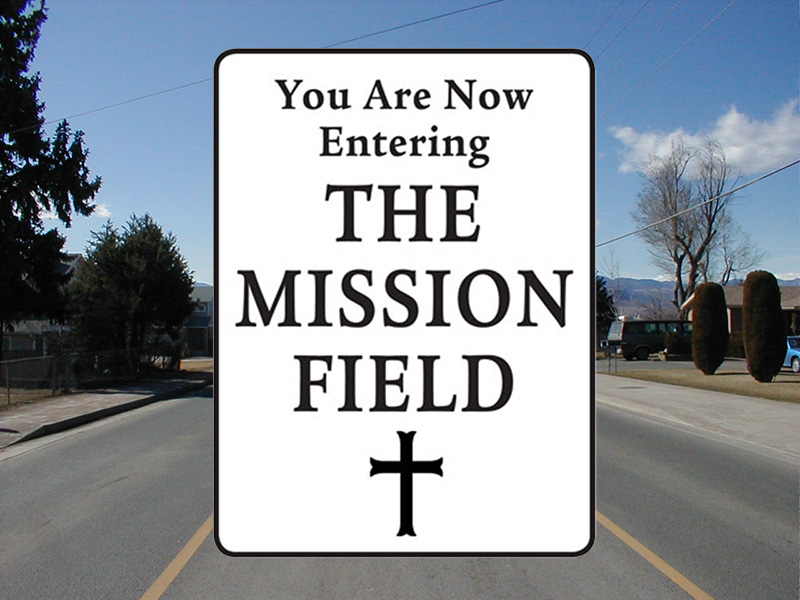
Some Church buildings have a sign hanging above their doors saying something along the lines of, “Now entering the Mission Field.” I like this, mostly because it is an unequivocally true statement. Far too often we get caught up in the “far off” and “exotic” places when we start to think about missions. I’m not sure why this is… Perhaps its because we have been trained up to understand a mission as one who goes to a foreign land in order to proclaim the Gospel. The Apostle Paul, in that way, then, is a chief example of this. There is nothing wrong with this type of thinking. And if this is you, or someone you know and love who has made the sacrifice of the creature comforts of home, we give thanks to our Lord above!
Another possibility for this type of reasoning, though, is perhaps a more sinful. If the “Mission Field” is a million miles away, far out there somewhere that I will never stumble across without intentionally doing so, then I am kind of off the hook, aren’t I? That isn’t to say that each and every single person is, or should be, a missionary in the strictest sense of the term, but the Christian is given to always be prepared to give a defense for the hope that they have within them. And so if the “Mission Field” doesn’t include the neighbor that we are living next to or the co-worker we have lunch with or the family member in need of the love of Christ; but instead is always reserved for the stranger of a different language, then 95% of us are never going to enter the “Mission Field”.
With that said, though, there is a danger with think that the “Mission Field” begins once you exit the Church building on Sunday, and that is you forget about all of the people inside. Again, I suppose in the strictest sense of the word those within wouldn’t be part of the “Mission Field” because they are already receiving the gifts of our Lord, but isn’t it good for the Church to make sure that those within will be there to hear God’s Good Word for generations to come?
I don’t say this to pit one generation over and against another, and I don’t think we at WRELC do that in any stretch of the imagination. But I do want to encourage us to take a look at the demographics of our small, little congregation. First, by LCMS standards we aren’t small, we are actually above the median in both members and attendance. Second, the amount of children we have squeaking and squawking and squirming during the Divine Service is amazing!
Our congregation knows and understands that the fulness of Church, everything that we receive within these walls during the Divine Service, is for kids, too. “Let the little children come to me,” could almost be our moto. I also love the way in which our congregation has been investing in the children and youth within our walls. We are training our children to know their Lutheran faith, that they might not just be Lutheran kids, but grow up to be Lutheran adults with Lutheran spouses and Lutheran children of their own!
So let us be glad to continue such a tradition within our congregation. Let us keep searching for more ways (spiritual, material, temporal, financial, etc.) to train up the next generation; while also to encouraging and supporting the gambit of generations we have within our walls. And let us also seek to serve and to share the gifts of Christ with those outside our walls whom we live, work, and play next too. And finally, if the Lord grants it one day, let us jump at the chance to walk within the “Mission Field” that is on the other side of the ocean that they too might know the wonderful gifts of our Lord.
May Christ grant us the strength to endure and remain steadfast, trusting in the Holy Spirit to create, strengthen, call, gather, enlighten, and keep His true Church faithful here on earth!
In Christ,
Rev. Eli Lietzau
**********************************************
Something Worth Reading
[All books are available in our church’s library or may be borrowed from the pastor]
25 This Side of Glory: Celebrating 25 years of Higher Things
“The Feast for the Unworthy Sinner”—Eli Lietzau
Worthless beggars is all that we are, is all that we could ever be. Empty sacks are the only thing that we bring to the table. But our Lord wouldn’t have it any other way, for it is the sick who are in need of a physicians and who among us aren’t laden with that sinful disease that leads us to death? Grumbling bellies, that have for far too long gorged themselves on the flirt of that deadly tree, are the only things that we can offer to God. But such an offering is acceptable to Him, for it comes from a broken heart and an contrite spirit starving for the feast of forgiveness.
What We Believe—The Formula of Concord, Epitome
I. Original Sin
Note: Is sin part of mankind’s very essence? No, for if it were, God could be accused of creating sin. However, sin is a very deep and thorough corruption of our human nature—a horrible and terrible corruption. No one except Christ Jesus, our Lord, can overcome this corruption for us and save us from it. Because of this sin, spiritually we are utterly and completely dead. But there is hope! As Christ raised Lazarus from the dead, so today He brings us to life again through His Gospel in Word and Sacraments. The biblical position on this issue is explained in Articles I and II. (See also AC II; Ap II; SA III I; FC SD I.)
AFFIRMATIVE STATEMENTS—The pure Teaching, Faith, and Confession according to the Standard and Summary Declaration Mentioned Before
- We believe, teach, and confess that there is a distinction between man’s nature and original sin. This applied not only when he was originally created by God pure and holy and without sin [Genesis 1:31], but it also applies to the way we have that nature now after the fall. In other words, we distinguish between the nature itself and(with even after the fall is and remains God’s creature) and original sin. This distinction is as great as the distinction between God’s work and the devil’s work.
- We believe, teach, and confess that this distinction should be maintained with the greatest care. For this doctrine (that no distinction is to be made between our corrupt human nature and original sin) conflicts with the chief articles of our Christian faith about creation, redemption, sanctification, and the resurrection of our body. It cannot stand with them.
God created the body and soul of Adam and Eve before the fall. But He also created our bodies and souls after the fall. Even though they are corrupt, God still acknowledges them as His work, as it is written in Job 10:8, “Your hands fashioned and made me.” (See also Deuteronomy 32:18; Isaiah 45:9-10; 54:5; 64:8; Acts 17:28; Psalm 100:3; 139:14; Ecclesiastes 12:1.)
Further more, God’s Son has received this human nature [John 1:14], but without sin. Therefore, He did not receive a foreign nature, but our own flesh in the unity of His person. In this way He has become our true Brother. Hebrews 2:14 says, “Since therefore the children share in flesh and blood, He Himself likewise partook of the same things.” Again, “For surely it is not angels that He helps, but He helps the offspring of Abraham. Therefore He had to be made like His brothers in every respect, … yet without sin” [2:16; 4:15]. In the same way, Christ redeemed human nature as His work, sanctifies it, raises it from the dead, and gloriously adorns it as His words. But original sin He has not created, received, redeemed, or sanctified. He will not raise it, adorn it, or save it in the elect. In the <blessed> resurrection original sin will be entirely destroyed [1 Corinthians 15:51-57].
The distinction can easily be discerned between (a) the corrupt nature, (b) the corruption, which infects the nature, and (c) the corruption by which the nature became corrupt.
- On the other hand, we believe, teach, and confess that original sin is not a minor corruption. It is so deep a corruption of human nature that nothing healthy or uncorrupt remains in man’s body or soul, in his inward or outward powers [Romans 3:10-12]. … As the Church sings, “Through Adam’s fall is all corrupt, Nature and essence human.”
This damage cannot be fully described [Psalm 19:12]. It cannot be understood by reason, but only from God’s Word. We affirm that no one but God alone can separate human nature and this corruption of human nature from each other. This will fully come to pass through death, in the <blessed> resurrection. At that time our nature, which we now bear, will rise and live eternally without original sin and be separated and divided from it. As it is written in Job 19:26-27, “After my skin has been thus destroyed, yet in my flesh I shall see God, whom I shall see for myself, and my eyes shall behold.”
Bible Study
Join us for Bible Study every Sunday before Service. Presently our focus is on, “Why we do what we do?”. This is a great opportunity to come and be reminded (or learn for the first time) why we worship the way that we do and how the Divine Service is structured to grant to us God’s good gifts. …. You are also invited to Midweek Bible Study each Tuesday morning at 10:00am. Currently, we are studying the book of I Kings. If you have not had the chance to join us for Bible Study please use this opportunity to begin fresh as we delve into the Word of God together.